Welcome to GET headless
The slow death of the GUI
Ramp, the expense management software known for pointed ads with Kevin from the office, did something interesting a few weeks ago. They announced a CLI (command line interface) for their users.
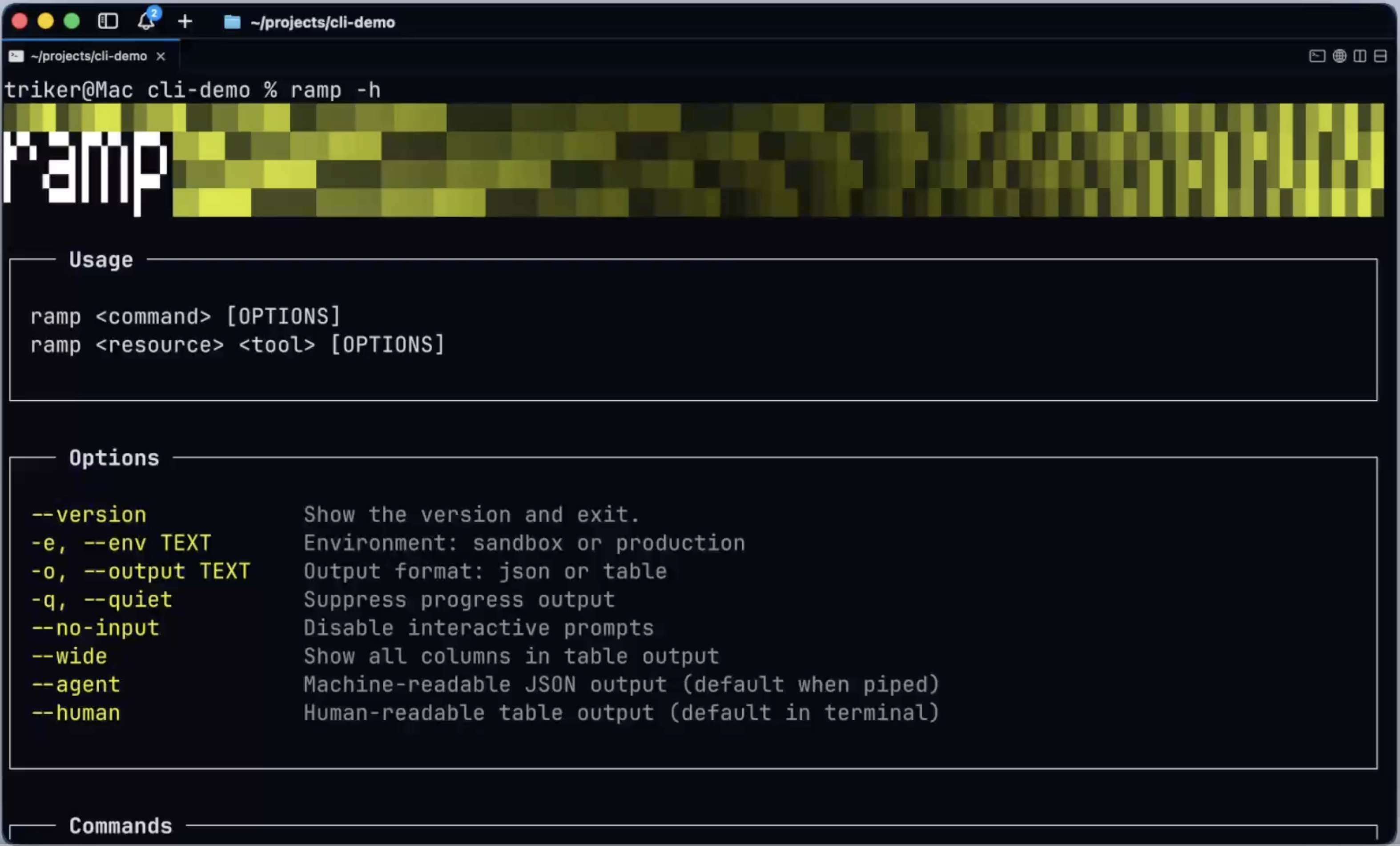
Ramp is used through a sophisticated, well-designed and user-friendly website and mobile app. Submitting expenses is easy because of their UI and automatically tracking transactions on cards they issue – supplanting receipt tracking via print-outs or Excel sheets (consultants used to do this!). Ramp became a multi $B business off the back of this UX revolution. Now they release a tool that uses boring text commands to do their core work of uploading, matching and filing away receipts.
This video shows why. Ramp’s CLI was not built for humans but for AI agents that operate on behalf of their operator or autonomously on their own. It allows an authenticated agent to complete the entire expense workflow. The agent figured out that a receipt was missing, found it on the user desktop and uploaded it. Ramp did the matching.
Core services through a text-based tool instead of an interface. This example demonstrates a fundamental shift in how AI changes software products being used and, most importantly, who uses them.
Welcome to the headless economy
AI models are now capable of completing complex, multi-step tasks in agentic workflows. What super-powers these workflows is the ability to select and use software tools to complete a task.
The implications of tool usage by agents is profound. As agents can use externally provided software, such as the Ramp example above, they become a user class in their own right. Agents use software like humans do – humans click, log in, drag, match, upload, filter, select. Often, the graphical user interface was the product.
Instead of GUIs, agents need access to structured data. And in the headless economy, that will happen through file systems, databases, APIs, MCP servers, CLIs. The rawer you are to the underlying data, the better. And not only Ramp has started paying attention to this:
- Cloudflare released a very large update to their CLI
- Salesforce announced “Headless 360”, allowing access to their GUIs via MCPs and code tools
- Supabase launched supabase.sh, a public SSH server that gives AI coding agents direct bash access to Supabase documentation
Agents as a new consumer class will also have needs. They need to discover the right software tool for the job, be able to understand them, be able to use them properly, be able to pay for them. They want authentication, access to pricing, reliability, trust, ability to pay and more.
“Agents don’t read your ad. They query a registry, get structured results, and pick the best option in milliseconds. Your pricing page becomes a machine-readable header. Your sales funnel collapses into three HTTP calls: discover, authenticate, buy.” – Simon Taylor, Fintech Brainfood
Businesses are building for this new class of users and their needs constitute the headless1 economy, where a GUI for humans will become optional. It’s the emerging market in which agents discover, evaluate, access, pay for, and consume digital goods and services through machine-native interfaces2.
The product shape per se aren’t new. APIs and API-first businesses have existed for decades. What’s changed now is the actor, agents, not all of which consume in the same way. There are three distinct patterns:
- Agent-as-consumer: The agent directly consumes the capability or output as part of its own workflow. OpenClaw agents fall into this category – autonomously working the web.
- Agent-as-intermediary: The agent acquires a good or service on behalf of a human or organization, but is not the ultimate consumer of that good.
- Hybrid: The agent consumes intermediate goods or capabilities in order to generate an output for a human or another system.
And the opportunities are enormous, with clear implications:
- The value of human-centric interfaces will decrease, unless they marry human-native and machine-native. Businesses that built their moat around UX might be in for a rude awakening
- The value of businesses that provide seamless access to agents while building infrastructure that abstracts complexity away from agents will increase. Stripe still needs to build world-class financial infrastructure. Ramp still needs to provide world-class receipt-to-transaction matching and issue credit cards.
- It might give rise to new types of businesses that don’t need to cater to humans at all.
“The biggest opportunity in agentic commerce (…) is building headless merchants. The next generation of merchants won’t have storefronts. They’ll have endpoints.” – Noah Levine, a16z
GET /headless
get: command, invoke, retrieve. In ordinary English, get can function as an imperative
GET: HTTP method that requests a resource on the web, its primary retrieval primitive
My first job was taking terabytes of datasets on KPIs on publicly traded companies and distilling them down into 5 bullet points. This enabled investors to make well-informed bets on their stock prices. The companies we were covering were all creating entirely new markets or reinventing existing ones: Doordash, Alibaba, Uber, Carvana, and others.
Now, the headless economy, an entirely new market, will be powered by the functional basics behind my previous work – structuring, slicing, reducing, querying, vetting complex sets of data into single verifiable facts. And finally, my current employer Stripe, is at the cutting-edge of this new market, with the machine payments protocol, Stripe projects and a myriad of other initiatives. Covering the headless economy in this website thus is a perfect match.
GET /headless is a hub for everything around this new market. We will be publishing a regular newsletter and providing tooling for humans and agents that want to learn more. Some of the key themes we want to address:
- What businesses are being built specifically for agent demand?
- How do incumbents adapt existing products for machine-native consumption?
- What is the infrastructure enabling it? APIs, CLIs, SDKs, MCP servers, agent protocols?
- How is pricing and access models for machine consumers going to change?
- How will discovery, selection, and distribution work when the customer is software?
- How to think about trust, identity, and authorization in agentic systems
We’re early. The new agent consumers in the headless economy are just starting to roam. Most of the businesses that will define the headless economy do not exist yet.
This is their home.
Footnotes
-
Headless originates from headless software, that does not rely on a “head” or graphical user interface (GUI). Pre-agentic, the term was often used to describe “headless content management systems”. These are systems that allow you to surface content in a structured manner, such as this blog, but without supplying a GUI as a service. ↩
-
Some call these “machine” or “agent to agent (A2A)” markets. ↩